Metal cutting
Metal bandsaw blade TPI chart and selection guide
Learn what TPI means and compare bandsaw blade tooth pitches for metal tube, profiles and solid steel, including 6/10, 5/8, 4/6 and 3/4 TPI.
Metal cutting
Learn what TPI means and compare bandsaw blade tooth pitches for metal tube, profiles and solid steel, including 6/10, 5/8, 4/6 and 3/4 TPI.
Quick answer
TPI means teeth per inch. Higher TPI keeps more teeth in thin sections; lower TPI creates more chip space in large solid sections. For tube, start with wall thickness. For solid bar, use the full diameter or width.
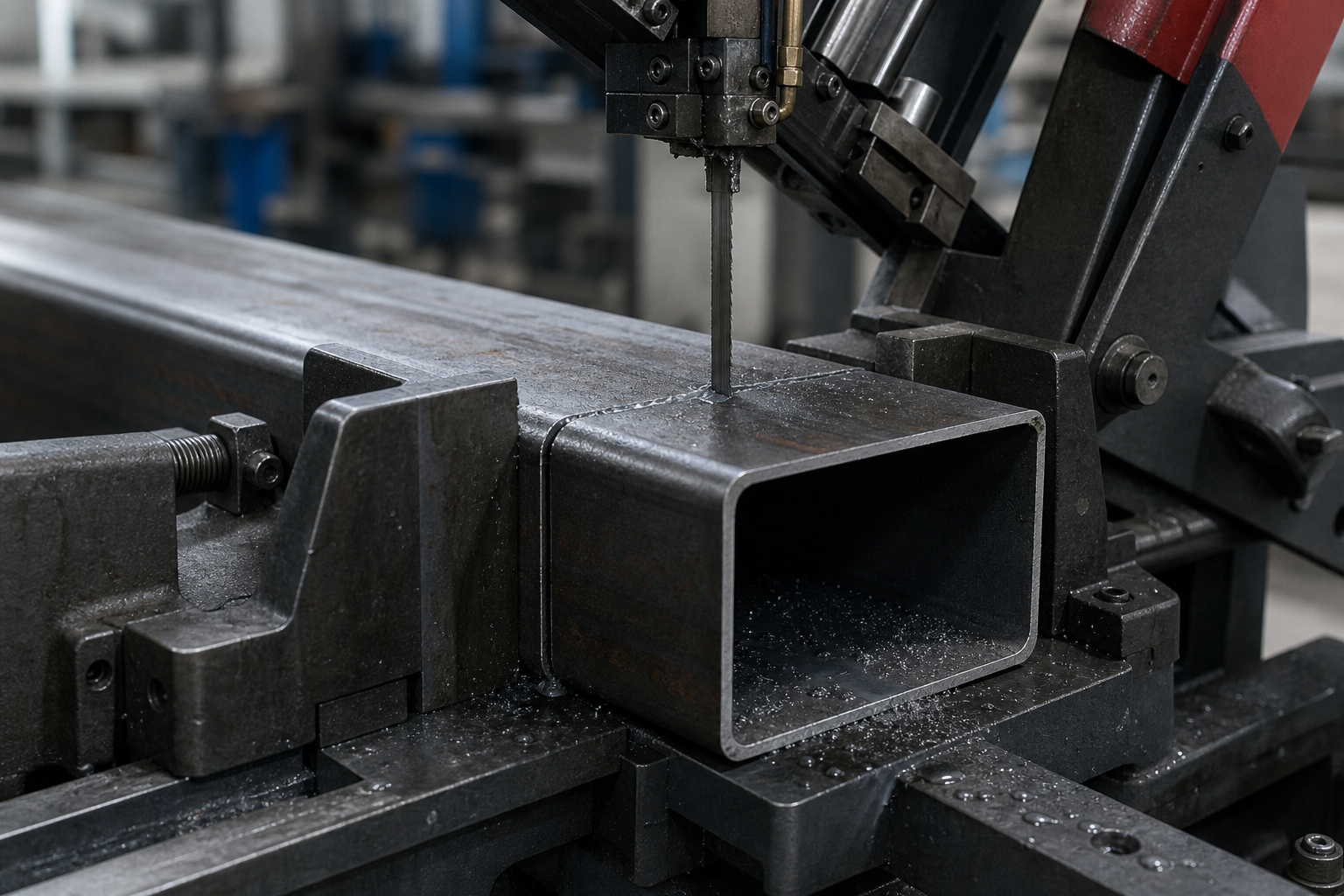
Tooth pitch controls both engagement and chip capacity. The useful question is not simply “what metal am I cutting?” but “how much material does the blade contact at the widest and narrowest points?”
More, smaller teeth stay engaged. This reduces snagging in thin walls but leaves less gullet space for chips.
Fewer, larger teeth create chip space for wide solid sections. On thin material, too few engaged teeth can catch and strip.
Alternating tooth spacing interrupts repetitive cutting forces, helping control noise and vibration across profiles and mixed sections.
Use the full diameter or section width that the blade crosses. These ranges are starting points for metal-cutting bandsaws, not substitutes for machine and blade-manufacturer limits.
| Engaged solid section | Starting pitch range | Typical use |
|---|---|---|
| Under 13 mm / 1/2 in | 10/14 or 8/12 variable | Small solid bar and narrow sections |
| 13-25 mm / 1/2-1 in | 8/12 or 6/10 variable | Small solid steel and heavier profiles |
| 25-50 mm / 1-2 in | 6/10 or 5/8 variable | Small-to-medium solid sections |
| 50-100 mm / 2-4 in | 5/8 or 4/6 variable | Medium solid steel |
| 100-200 mm / 4-8 in | 4/6 or 3/4 variable | Medium-to-large solid sections |
| Over 200 mm / 8 in | 3/4 or 2/3 variable | Large solids; confirm machine and blade technology |
Start with wall thickness, then check the maximum span engaged as the blade crosses the workpiece. Bundles need a separate review because the number of walls in the cut changes continuously.
| Tube wall thickness | Starting pitch range | Selection note |
|---|---|---|
| Under 2 mm / .080 in | 14/18 or 10/14 variable | Very thin wall; avoid tooth snagging |
| 2-5 mm / .080-.200 in | 10/14 or 8/12 variable | General thin-wall tube and profiles |
| 5-10 mm / .200-.400 in | 8/12 or 6/10 variable | Heavier tube and structural profiles |
| Over 10 mm / .400 in | 6/10 or 5/8 variable | Heavy wall; also check the maximum engaged width |
A 100 mm thin-wall tube does not behave like a 100 mm solid bar. For rectangular tube, angle, channel and bundles, send both the wall thickness and overall profile dimensions.
6/10 is a variable pitch, not 6.10 TPI. Tooth spacing changes between approximately 6 and 10 teeth per inch. The variation helps prevent one cutting frequency from repeating across the blade.
The examples below connect pitch to real starting applications. Final fit also depends on blade dimensions, tooth form, material grade and machine condition.
A fine-to-medium variable pitch that controls vibration while retaining chip space.
A versatile production pitch when one blade must cover several section types.
More tooth space than finer pitches for carrying chips out of a wider cut.
A coarse variable pitch for chip clearance in larger production cuts.
A coarse pitch often paired with carbide on rigid production machines.
Use the chart as a starting point, then verify the conditions that determine whether the pitch will work in production.
Pitch is only one variable. Use these symptoms to start diagnosis, then inspect speed, feed, blade tension, guides, coolant and tooth condition.
The pitch may be too coarse, leaving too few teeth in the wall.
The pitch may be too fine for the engaged section, or feed/coolant may be incorrect.
Tooth engagement may be unstable; compare a variable pitch and check machine condition.
Too many teeth may be rubbing instead of cutting; also check speed, feed and coolant.
Do not blame TPI alone: inspect blade tension, guides, tooth condition and feed pressure.
Direct answers to common pitch questions. This guide covers continuous-loop metal bandsaw blades, not hacksaw or reciprocating-saw blades.
TPI means teeth per inch. A higher TPI puts more, smaller teeth in the cut and is generally used for thinner sections. A lower TPI provides larger tooth gullets for carrying chips from wider solid sections.
There is no single best TPI for every metal cut. Choose pitch from the amount of material contacted by the blade: wall thickness for tube and the full diameter or width for solid stock. Material grade, blade width, machine condition, feed and coolant also affect the final choice.
6/10 TPI is a variable pitch in which tooth spacing changes between approximately 6 and 10 teeth per inch. It does not mean 6.10 TPI. The changing spacing helps interrupt repetitive vibration when cutting tube, profiles and mixed sections.
Ten TPI can be a useful starting point for thin tube, profiles and small solid sections, but the correct choice depends on tooth engagement. It may be too fine for a large solid because the smaller gullets can fill with chips.
Neither is universally better. A 24 TPI blade is intended for very thin material where enough teeth must remain engaged. Fourteen TPI provides more chip space and suits somewhat thicker sections. Production bandsaws commonly use variable pitches rather than choosing only between these two fixed pitches.
Three TPI is coarser and provides more chip space for large solid sections. Five TPI keeps more teeth engaged and is usually a better starting point for smaller sections. Confirm that the coarser choice will not leave too few teeth in the cut.
Choose aluminum blade pitch by section size and shape, not by the material name alone. Aluminum forms large chips, so avoid an unnecessarily fine pitch on solid stock. Thin aluminum tube still needs enough teeth engaged to prevent snagging.
A common starting rule is to keep at least 3 and no more than about 24 teeth engaged in the workpiece. Fewer teeth can catch or strip; too many can rub and restrict chip clearance. Treat this as a selection check, then confirm the blade maker and machine recommendations.
Quotation support
Share the workpiece shape, material grade, wall thickness or solid diameter, blade size and machine model. We will review pitch, blade fit and quotation details.